
Soft Serve & Soft Power
Exploring New York City's Foreign Chains (P1)

Reader’s Note: I moved to New York, which if you’re reading this you probably already know. I’ll keep writing my DC lists, but now they’ll be interspersed with dispatches from my new home.
Stuffed with rava masala dosa at Saravanna Bhavan, I studied a map of the South Indian chain’s global footprint. How hard would it be to eat at every foreign chain restaurant in New York City? Like the best projects, what began as a simple question has now morphed into a three-part series.
This newsletter will focus on what countries the foreign chains in New York come from and what that says about economic and cultural cachet. Second, I’ll look at where foreign chains cluster in the City, and in the last letter I’ll share my predictions about what chains we can expect to see next in the U.S. Each newsletter will also have reviews of the different locations.
Why study foreign chains at all? There are several reasons I find this fascinating:
Food as a form of cultural currency. When Luckin Coffee — a Chinese chain — becomes ubiquitous enough that you can walk around New York collecting stickers from each store, it creates brand familiarity at scale. First, customers become accustomed to a specific brand. Then they grow more comfortable with the broader idea of that country exporting culture to the U.S. We’ve seen this trend before with items like K-beauty or bubble tea.
A way to map diasporas. Foreign chains often land first where their diaspora already lives. New York’s only Haidilao is in Flushing. The first Jollibee opened in Woodside — New York’s “Little Manila.” And these trends change with time. Many of the newer-entrant Chinese chains are clustered around the East Village to meet demand from the many Chinese students at NYU.
Most chains are good. If a brand has scaled to hundreds — or thousands — of locations and still decides New York is worth the rent, it has likely built a model that works. As a diner, that means you’re assured a reliable experience. And, if you’ve been lucky enough to visit that chain in another country, you can compare how the restaurant has been tweaked for the U.S. market.
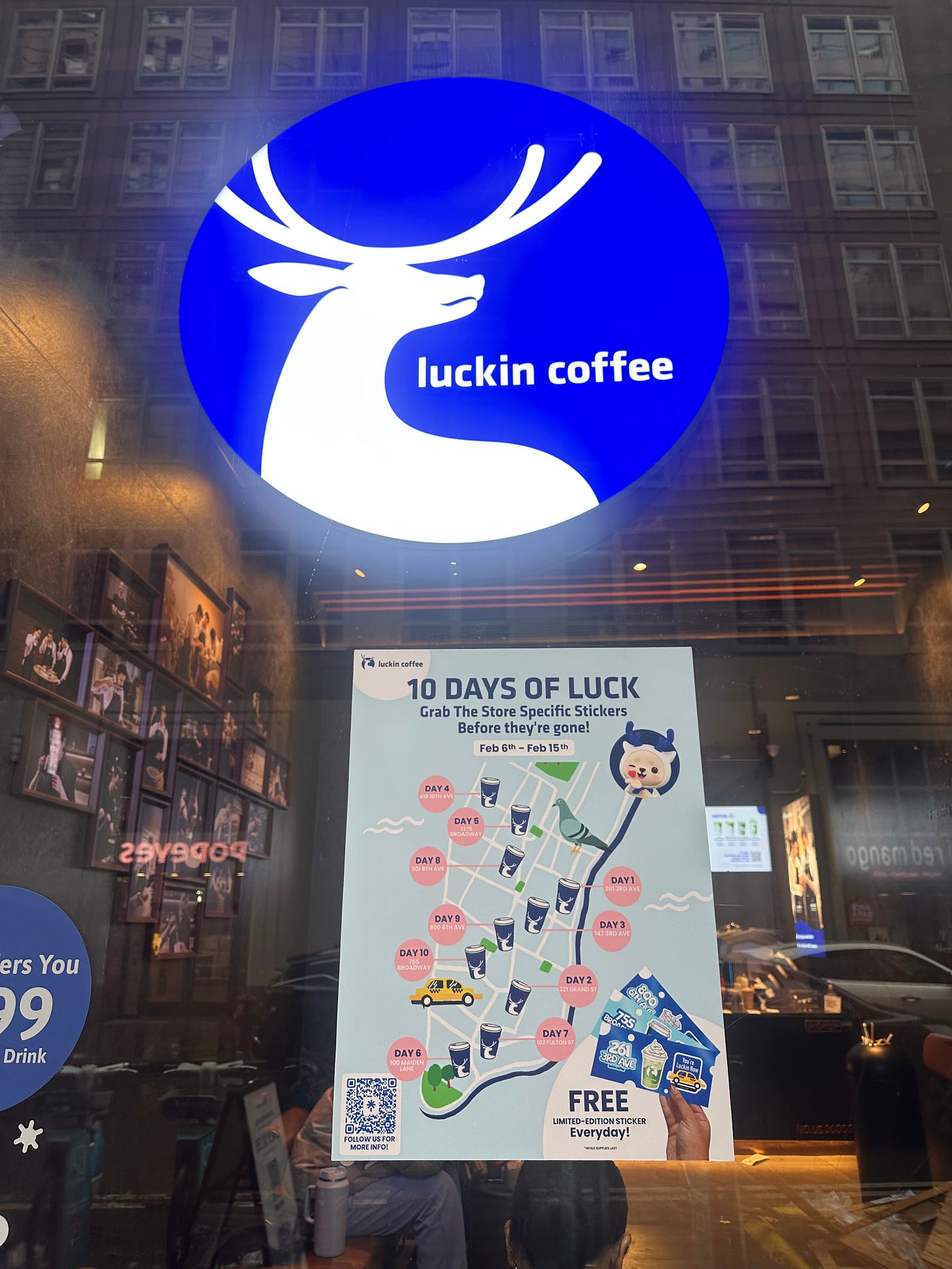
The Luckin Coffee tour of New York
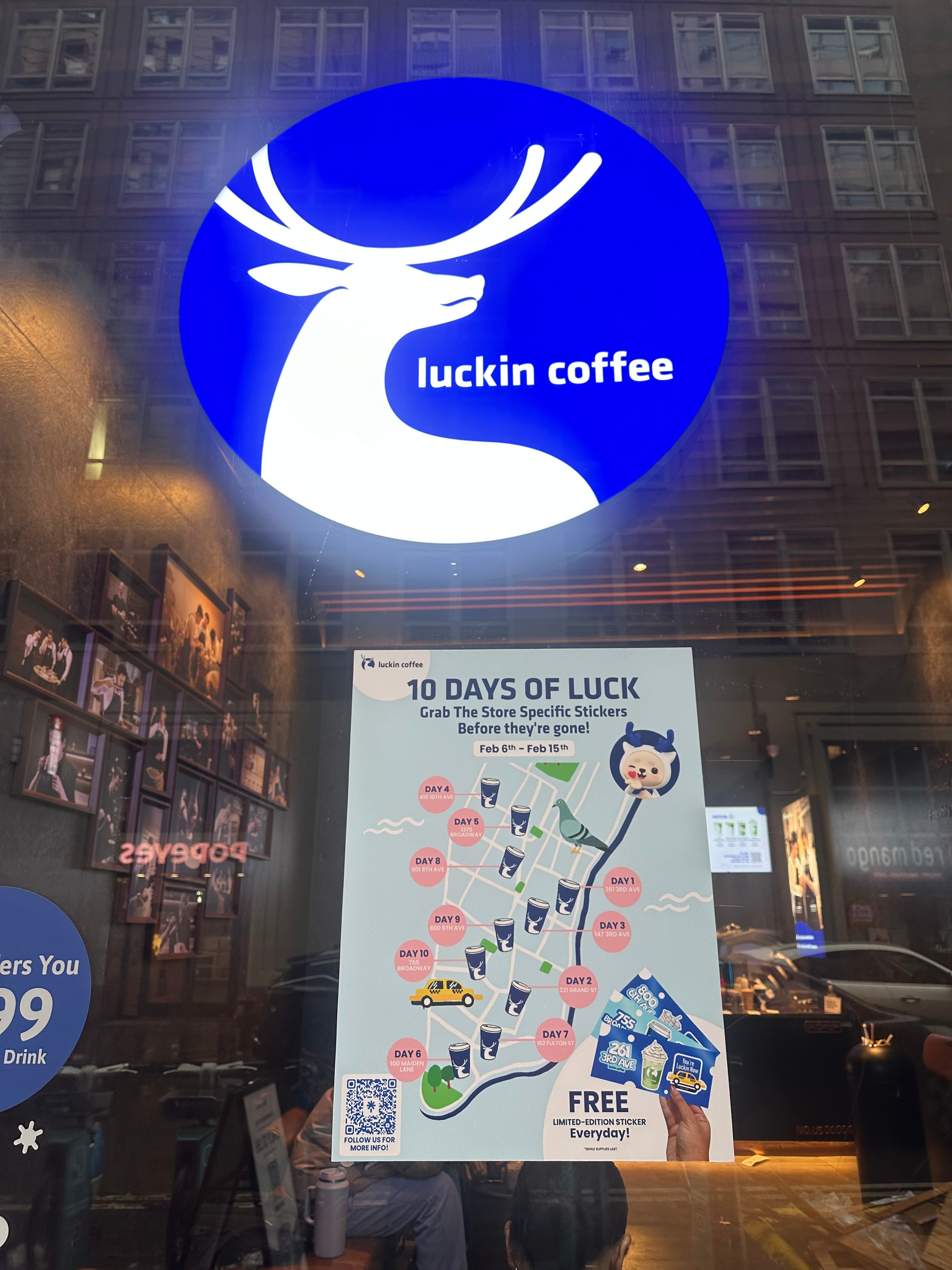
The Ground Rules
For my highly arbitrary quest, I made highly arbitrary rules. A foreign chain is a restaurant founded, headquartered, and majority-owned outside the U.S., with 100+ locations worldwide and at least one in New York. Two chains didn’t make the cut because they’re now mostly U.S.-owned: Joe & The Juice (Danish — who knew?) and the Belgium-founded Le Pain Quotidien. Additionally, many of the chain locations I visited are actually run as franchises.
Why the 100+ location requirement? This seemed like an appropriate threshold to capture chains operating with true scale, without yielding an excessive number of restaurants.
Foreign Chains in New York by the Numbers
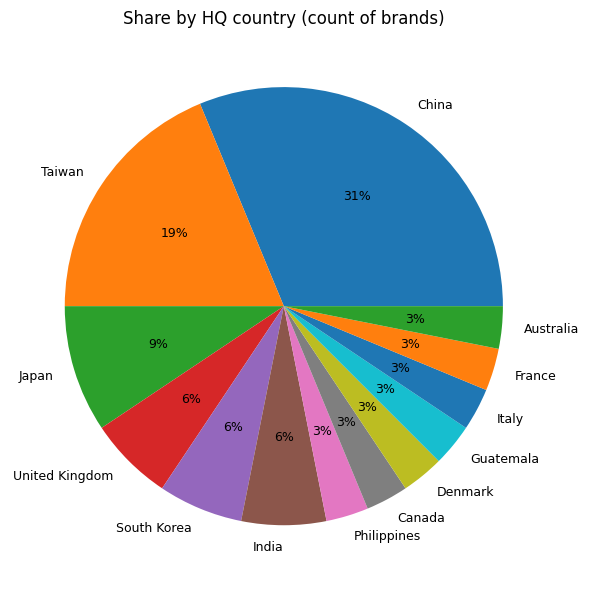
32 chains representing 13 countries
These chains have 223 branches in New York, and there is at least one foreign chain in each of the five boroughs.
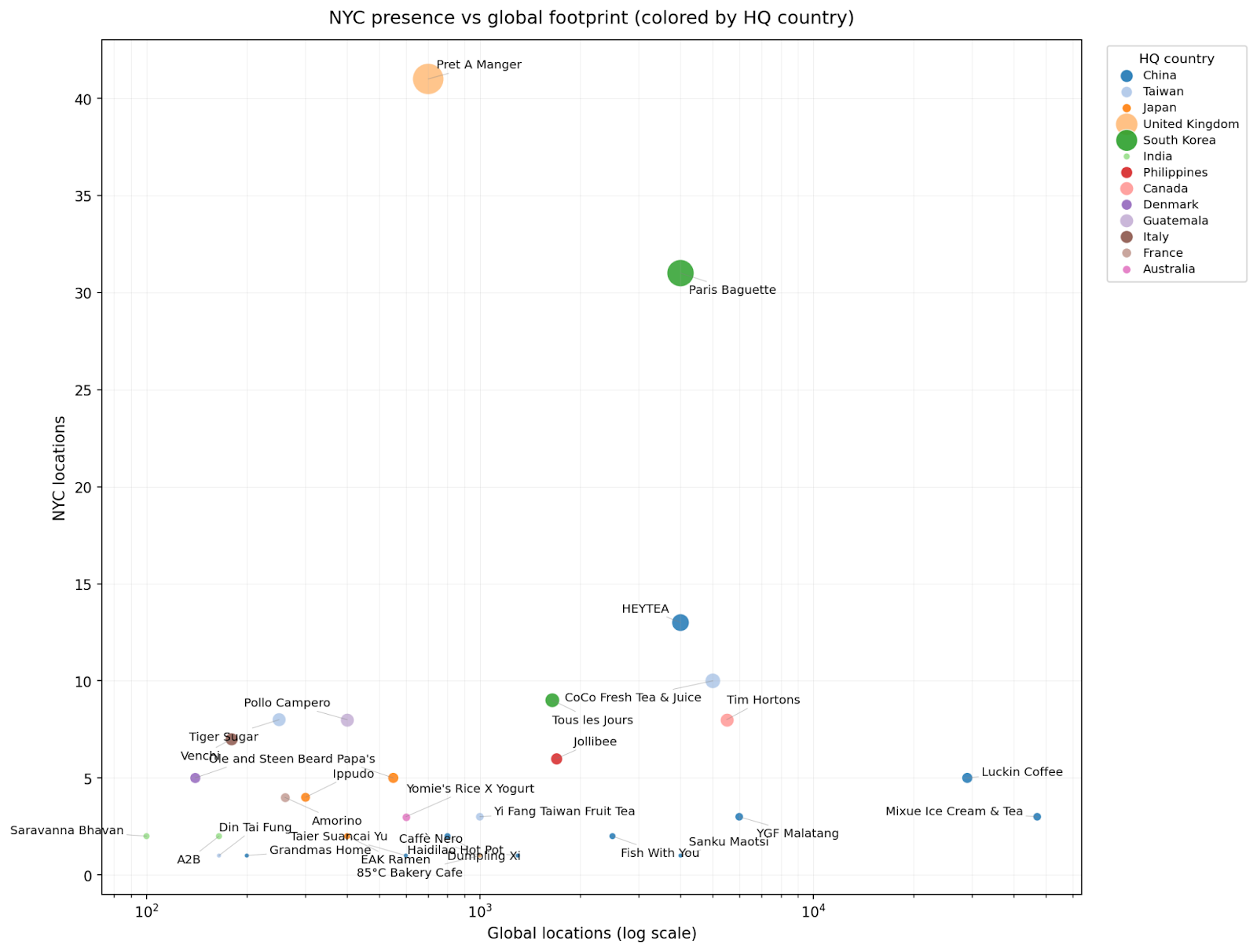
These chains have ~120,500 total stores worldwide. More than half of those come from just two Chinese chains: Luckin Coffee and Mixue.
East Asian countries dominate the foreign chain scene in New York. Nearly a third of all foreign chains are Chinese, and Taiwan is a close second at almost 20 percent ( almost all of which are bubble tea brands). In third place is Japan at almost 10 percent. In total, chains from East Asia account for 65 percent of all foreign chains in the city. Most other countries pale in comparison, with only one chain restaurant in the City (or 3% of the overall count of New York foreign chains).
India, in particular, lags relative to its population size, with just two foreign chains in New York — both South Indian dosa restaurants. Meanwhile, Guatemala and Denmark punch above their weight, each boasting a well-known New York chain despite far smaller populations.
Pret a Manger and Paris Baguette far outpace every other chain in terms of New York locations as a share of their worldwide footprint — to the point that both now feel almost domestically ingrained. Both also serve more westernized food. Many Chinese chains, by contrast, are still early in their U.S. expansion and have an enormous base of domestic stores, and so understandably have a relatively modest New York presence so far relative to their overall size.
The growth trajectories also differ sharply by country. Chinese chains have surged into the U.S. since the mid-2010s. Taiwanese brands have expanded more gradually, while South Korean chains plateaued after the early 2000s. The acceleration of Chinese entrants follows years of explosive domestic growth. This has left many consumer categories in China — especially tea, dessert, and fast-casual concepts — oversaturated and facing cutthroat competition, pushing brands to seek growth abroad. The U.S., in contrast, offers higher margins, global prestige, and a powerful signaling effect. At the same time, Beijing has also encouraged companies to expand overseas as part of a broader “go global” push. Post-pandemic has proved a prime time for such expansion given the rise in brick-and-mortar retail vacancies and younger consumers’ growing fondness for novel, Instagram-friendly dishes.
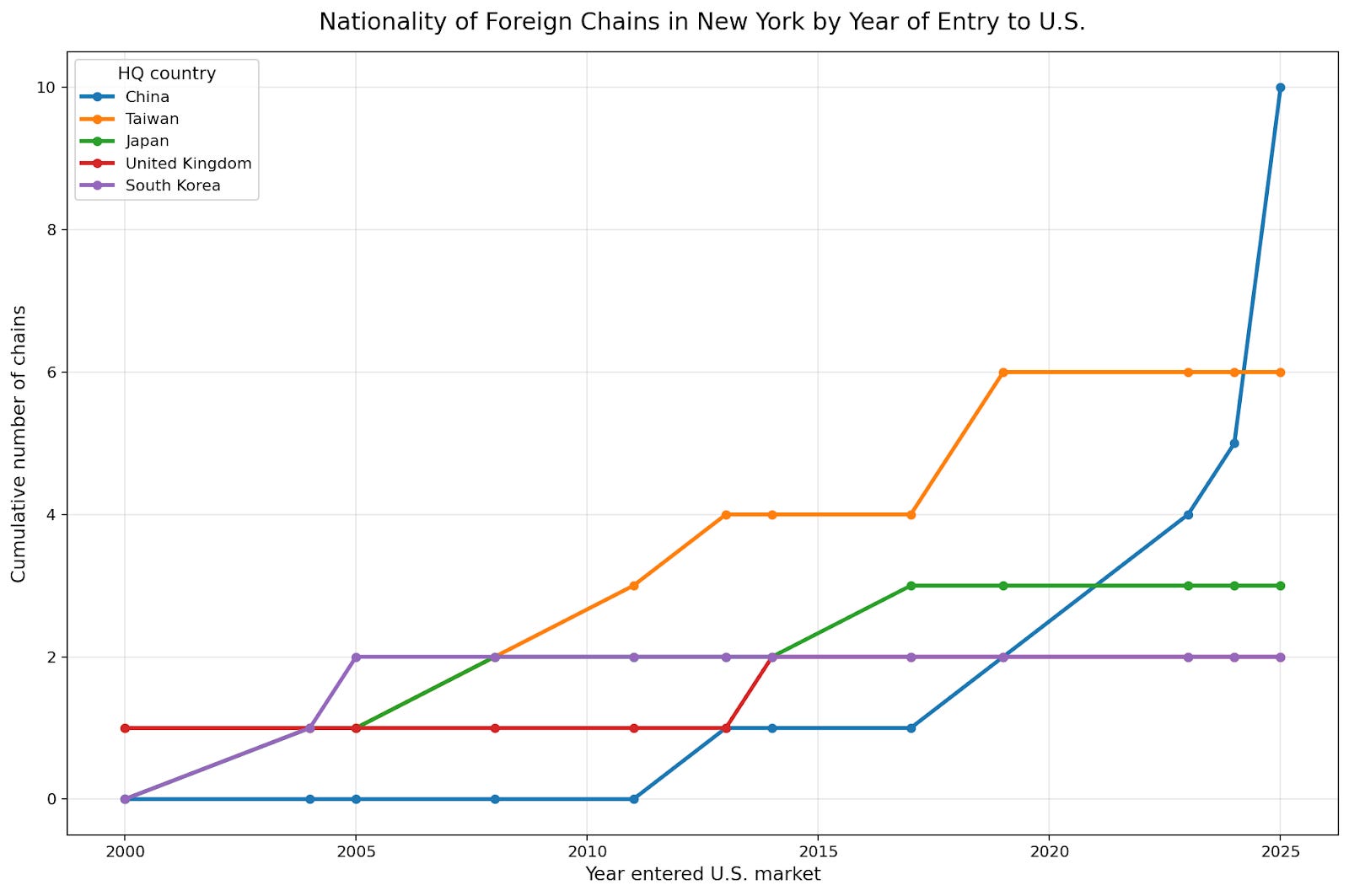
The arrival of so many Chinese chains to New York in recent months has garnered much press, but often forgotten is the fact that there have been waves like this before. In 2017, Eater proclaimed: “New York has become the go-to market for countless Japanese chains looking to open their first stateside locations.” But many of those restaurants have now shuttered in New York (including a restaurant in Chelsea where you could apparently fish for your own dinner!). Will these Chinese chains suffer a similar fate? Time will tell, but in the meantime I’ll be eating well.
Reviews
Now on to the first set of reviews:
Mixue (China; 47,000+): The largest chain restaurant in the world? Not McDonald’s – Mixue. This snow king of foreign chains offers just two items: soft serve ice cream or bubble tea, each of which is astonishingly cheap. An ice cream cone - either matcha or plain - will only run you $1.19, while a small bubble tea is $3.99.
Mixue has reportedly taken a lesson from Costco and uses the ice cream cone as a loss leader to get people into the shop. Still, nothing there at Mixue will set you back much by New York standards. The mango sundae with taro pearls was a whopping $4.42. While the mango syrup tasted highly artificial, the soft serve had a subtle vanilla flavor nicely complemented by the chewy pearls.
On a Tuesday night with temperatures below freezing, the shop still brimmed with customers taking selfies with their cones and a life-size mascot. In the background, tinny notes of Mixue’s theme song echoed in my ears: “I love you, you love me; Mixue ice cream and tea.” In New York, this song loops continuously in English and Mandarin, but a restaurant employee told me it’s available in 24 languages based on a given store’s locale. If you, too, want to have it stuck in your head for days you can listen to a clip below.
Dumpling Xi (China; 800+): Unlike Grandma’s Home, Dumpling Xi does nothing to hide its scale. Walking by, a jubilant red and white dumpling statue and sign proudly proclaim: “Over 800 chain stores worldwide.” As the name suggests, each of those 800 stores specializes in dumplings. The steamed egg, shrimp, and chive dumplings were excellent: chewy skins, large chunks of shrimp, and an abundance of garlicky Chinese chives. Despite having spent a summer in Heilongjiang Province, where Dumpling Xi originated, I had never encountered several of the other dishes the chain serves, including lotus root-shaped noodles, served cold and topped with cucumbers and sesame sauce.
What impressed me most, however, was the quality of the takeout packaging. The dumpling container had a two-tiered tray with divots molded to cradle each dumpling. And individual packages of all of the condiments – garlic, soy sauce, black vinegar, and chili crisp – were automatically included.


Grandma’s Home (China, 200+ locations): If you stumbled upon this restaurant in Flatiron, you would never know that it is part of a mini-empire in China. The restaurant focuses on Jiangnan cuisine, known for its refined flavors and abundant use of seafood. Everything I tried was excellent and quite different from many of the more standard Sichuan dishes you’re likely to find in New York. Particular favorites were a sweet and savory fried eggplant; white fish laid atop a profusion of roasted garlic cloves; and Longjing shrimp, an iconic Hangzhou dish of delicate shrimp stir-fried with green tea leaves.
The restaurant’s design was also impeccable. Modern Chinese art festooned the walls and next to each place setting lay a chopstick holder in the shape of a different zodiac animal (for sale as a set for an auspicious $88).


E.A.K Ramen (Japan; 400): Most theater district folks who stumble into this ramen restaurant and izakaya on West 46th Street probably have no idea it’s a chain. E.A.K., better known as Machida Shoten in Japan, specializes in Iekei ramen, a style from Yokohama that employs a broth of pork bone, soy sauce, and oil. My vegan mushroom version featured springy green noodles immersed in a pleasantly rich soup. The vegetables were overcooked, however, and there are many bowls of superior ramen in the City.
Beard Papa’s (Japan; 550): Sometimes my lists bring me to gems I would never have tried otherwise. Beard Papa was one of those. The stores almost exclusively sell cream puffs , which have a pleasantly thin and pliable choux pastry and ooze with a not-too-sweet matcha cream. The Beard Papa mascot also starred as a security guard in Wreck-It Ralph. Being animated in a Disney film - the ultimate sign you’ve made it in America?


Paris Baguette (South Korea; nearly 4,000): Paris Baguette is pushing hard to get to 1,000 U.S. franchises by 2030, so it should have been no surprise that one opened across from my subway stop last year. The menu is vast with breads, pastries, cakes, and savory items such as crab meat croquette and garlic sausage buns. The quality of the pastries is good enough, but I wouldn’t regularly seek them out.


Tous les Jours (South Korea; 1,740): Tous les Jours feels like a more upscale Paris Baguette: the lighting is a little warmer, the color scheme pale wood and moss green rather than bright white, and the pastries appear more artisanal. These pastries also have more explicitly East Asian flavors, such as a bean paste cookie stuffed with green pumpkin, or a sticky rice donut with a texture and red bean paste filling evocative of a dim sum sesame ball.
Both Tous le Jours and Paris Baguette are also reminders of the mind-spinning amount of globalization at play. The only two South Korean chains on this list have French names and sell interpretations of French/Viennese pastries.
Venchi (Italy; 180): When Silviano Venchi founded his eponymous chocolate shop in 1878, he surely did not imagine that less than two centuries later, one of his shops would house North America’s largest chocolate waterfall. But here we are. From free samples to impeccably labeled packaging, the experience feels elegant throughout. I particularly like their arancia (dark chocolate and orange), but you should pop a selection into your pick-and-mix bag.


Pret a Manger (UK; ~700): Pret is decidedly a chain. One that’s reliable and seemingly fresh but nonetheless feels quite mass-produced. What’s striking, though, is how domestic market size shapes scale. Pret has grown at roughly half the pace of Dumpling Xi, yet operates in 19 countries compared to Dumpling Xi’s two.
Ole and Steen (Denmark; ~150): This bakery boldly embraces its Danish origins unlike Joe & The Juice. A cardamom bun is the test of any Scandinavian bakery, and theirs delivers: chewy, caramelized crust; well-shaped; and generous spice. I would happily return for a smoked salmon smørrebrød, a traditional open-faced sandwich (and the bakery’s ample seating doesn’t hurt!).


Loved this so much, especially the recording of Mixue’s theme song
> Guatemala and Denmark punch above their weight, each boasting a well-known New York chain despite far smaller populations
Guatemala's isn't THAT much smaller than Taiwan's.